- If your nose tip still feels hard and looks bulbous several months after rhinoplasty, the cause is often scar tissue (fibrosis)—excess collagen laid down while the wound healed.
- If the tip is gradually pulling upward, getting shorter, turning red or changing shape, capsular contracture around an implant or inflammation is possible, and your surgeon should see you first.
- When scar tissue is the main cause, Dr. Sun Clinic treats it with a laser-based approach without cutting it out; a session for surface nasal scar tissue takes 20–40 minutes, often one session is enough, and some cases need 2–5 sessions 2–6 weeks apart.
- Swelling and bruising laser can start from 2 weeks after surgery (4–8 weeks is recommended); if the hardness is unchanged after several months, scar tissue treatment is considered.
※ Results and side effects vary between individuals; an in-person examination is needed to confirm your condition.
“It has been seven months since my nose job and the tip is still hard as a rock. I can't tell if this is scar tissue or contracture, or whether I need revision surgery.”
Hello, this is Dr. Sun Clinic in Seoul, Korea.
Many people come to us long after rhinoplasty because the nose tip still pushes back firmly when pressed, seems frozen when they smile, or looks thicker and more bulbous in the mirror than they expected. Some are told it's contracture and needs revision; others, that it's still swelling.
A hard nose tip does not have a single cause. Based on the clinical experience of our medical director, Dr. Kang Jeong Joong, this article explains how to tell swelling, scar tissue, capsular contracture and implant problems apart, how scar tissue can be softened without revision surgery, and when you must see your surgeon first.
Videos from Dr. Sun Clinic
Why does the nose tip feel hard after rhinoplasty?
There are four main reasons a nose tip feels hard: swelling in the early months, scar tissue that forms as the wound heals, capsular contracture (the capsule around an implant thickening and tightening), and the natural firmness of cartilage grafts. Often several are mixed.
The nose tip has very little space between skin and cartilage, and it is an area where tissue is lifted widely during surgery. If too much collagen is produced during healing, thick, firm scar tissue settles under the skin. Scar tissue can make the tip look bulbous and larger, feel hard to the touch, and move less when you make facial expressions, as if it were stiff.
The more revisions a nose has had, the more often the same tissue has been injured, so scar tissue becomes more likely. And when the tip has been built up with ear, septal or rib cartilage, the cartilage itself is firm, so a certain amount of firmness can be a normal result of surgery.
How can I tell scar tissue, contracture and swelling apart?
Swelling is the most common cause in the first weeks to months. It feels soft yet tight, is worse in the morning, and gradually goes down over time. Swelling in the nose tip lasts longer than in other areas and can remain for several months.
Scar tissue keeps its hardness and bulbous shape almost unchanged even after several months, and when pressed it resists like rubber or stone. The shape usually does not keep changing. Capsular contracture, by contrast, is the capsule around an implant thickening and squeezing; it often comes with the tip gradually lifting, the nose getting shorter (an upturned, "piggy" look), and the skin of the tip becoming red or shiny.
Heat, worsening pain, pus or an implant showing through the skin may signal infection or an implant problem. An accurate distinction needs the surgery date, materials used, photos from the front, side and below, and how the tip feels.
Can nose-tip scar tissue be treated without revision surgery?
When scar tissue is the main cause, in many cases the tip can be softened without another operation. Dr. Sun Clinic does not cut or shave scar tissue and does not inject drugs. A laser-based treatment, combined with radiofrequency and micro-needles where needed, changes the scar tissue so that the body's natural healing process rebuilds it closer to your original skin.
Scar tissue in the surface of the nose, or a nose that looks swollen overall, is generally not very painful to treat, so it is usually done without anaesthesia, with a nerve block only when needed. If there is also scar tissue inside the nostrils or along the columella incision, it is treated on the same principle. The photo below shows scar tissue inside the right nostril two months after treatment.
However, if contracture is pulling the tip via an implant, or if a cartilage graft itself is what feels hard, scar tissue treatment alone will not fix the shape.
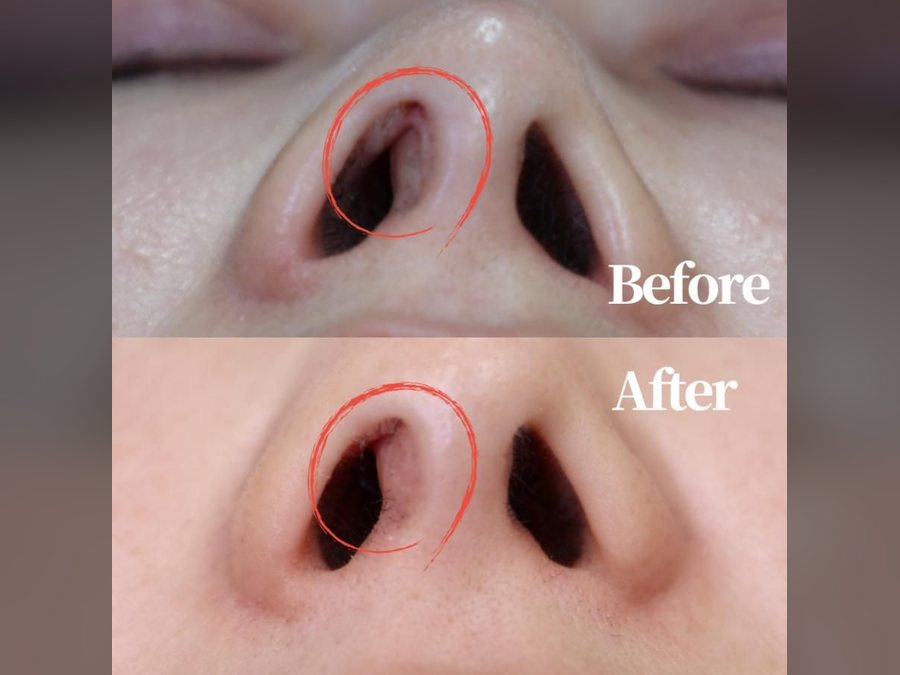
Before-and-after photos are unretouched photos of real patients. Results and how long they last vary by person. Like any medical procedure, treatment can have side effects such as pain, bleeding, bruising, swelling, infection, perforation, pigmentation or scarring. Please consult the doctor before treatment.
Unretouched photos of real patients, shown with consent. Eyes are masked. Results vary.
What do treatment and recovery look like?
Treatment of surface nasal scar tissue takes about 20–40 minutes per session. Often one session is enough; depending on thickness, 2–5 sessions 2–6 weeks apart may be needed. For scar tissue inside the nostrils, the anaesthetic injection stings sharply for 5–10 seconds, but the treatment itself is short—5 to 15 minutes—and barely visible from outside because it is inside the nose.
The result often looks best on the first day; there may be swelling for about a week, and the outcome is assessed at around 2 weeks. Disinfecting twice a day for 7 days is usually enough. Showers, light exercise and daily life are fine, but please avoid saunas and baths.
If laser channels must be made on the surface of the nose, downtime can last several months or longer, and we explain this thoroughly before treatment. If your surgery was recent, swelling and bruising laser (40 minutes to an hour, almost no downtime, usually one session) can be considered from 2 weeks after surgery, with 4–8 weeks being the recommended window.
When should I see my surgeon first?
If the tip is gradually lifting and getting shorter, if the skin of the tip is turning red and thin so the implant shows, if there is heat, pain or pus, or if the skin colour of the tip is darkening, contracture, infection or a blood-supply problem must be checked first. In these cases your surgeon or a plastic surgeon comes before scar treatment, and urgent symptoms mean contacting them right away.
Even if you have been told that implant removal or revision surgery is needed, you can discuss scar tissue treatment afterwards if remaining scar tissue bothers you. If you are unsure of the order, send us photos first.
How Dr. Sun Clinic treats it
Our medical director, Dr. Kang Jeong Joong, personally handles consultation, treatment and follow-up. Skin thickness and scar depth vary across the nose tip, so he checks the location and firmness of the scar tissue by touch and then designs a different combination and intensity of laser, radiofrequency and micro-needles for each part.
During treatment the combination is adjusted in real time as the tissue responds, and progress is checked with photos after each session to decide together whether and when to continue. If contracture or an implant problem is suspected, we do not rush scar treatment and recommend seeing your surgeon first.
3 key points
- A nose tip that is still hard and bulbous months after rhinoplasty is likely scar tissue, but it must first be told apart from swelling, contracture and firm cartilage grafts.
- When scar tissue is the main cause, a session for surface nasal scar tissue takes 20–40 minutes; often one is enough, and some cases need 2–5 sessions 2–6 weeks apart.
- A tip that is lifting and shortening, or that is red with heat or pus, may mean contracture or infection—see your surgeon first.
Questions patients ask
How long should I wait if my nose tip is hard after rhinoplasty?
Swelling in the nose tip can last several months. Swelling and bruising laser is possible from 2 weeks after surgery (4–8 weeks recommended); if the hardness is unchanged after several months, scar tissue treatment is considered.
What is the difference between nose-tip scar tissue and capsular contracture?
Scar tissue stays hard for a long time but the shape usually does not keep changing. Contracture often comes with the tip gradually lifting, shortening or turning red, so your surgeon should see you first.
How many laser sessions does nose-tip scar tissue need?
Surface nasal scar tissue often needs only one session; thicker scar tissue may need 2–5 sessions 2–6 weeks apart. Each session takes about 20–40 minutes, and results vary from person to person.
Can I return to daily life right after treatment?
Yes—showers and normal activities are fine; just avoid saunas and baths. There may be swelling for about a week, and the result is assessed at around 2 weeks.
If you are dealing with this
A hard nose tip does not always mean revision surgery. If it is swelling, time will help; if it is scar tissue, there may be a way to soften it without cutting again; if it is contracture or infection, your surgeon comes first.
Send us the date of your surgery, the materials used (if you know them), and photos of your nose from the front, side and below, and Dr. Kang Jeong Joong will personally review them and explain whether scar tissue is involved and how to approach it. Wherever you live, one photo is enough to start a consultation in 15 languages.
This has been Dr. Sun Clinic in Seoul. Thank you for reading.
Send us photos and Dr. Kang will review them and reply personally.
Evidence and references
- Seago M, et al. Laser Treatment of Traumatic Scars and Contractures: 2020 International Consensus Recommendations. Lasers Surg Med. 2020;52(2):96-116.2020 international expert consensus on laser treatment of traumatic and surgical scars and contractures. Not a study of nose-tip scar tissue specifically; individual results vary.
- Anderson RR, et al. Laser treatment of traumatic scars with an emphasis on ablative fractional laser resurfacing: consensus report. JAMA Dermatol. 2014;150(2):187-193.2014 expert consensus report on treating traumatic scars, centred on ablative fractional laser. Not a randomised controlled trial.
Related articles
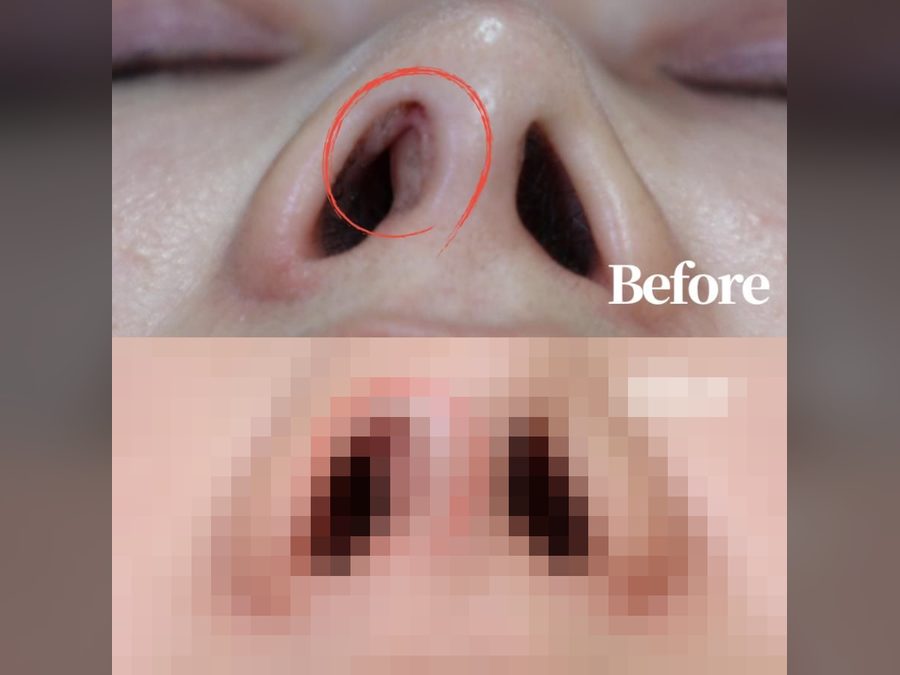
Hard scar tissue inside the nose after rhinoplasty: can laser reduce it without revision surgery? (with a real case)
Hard scar tissue inside the nostril after rhinoplasty can often be softened with combined laser and RF instead of revision surgery. Causes, treatment, recovery and a real case, explained by Dr. Kang Jeong Joong.
Dr. Sun Clinic column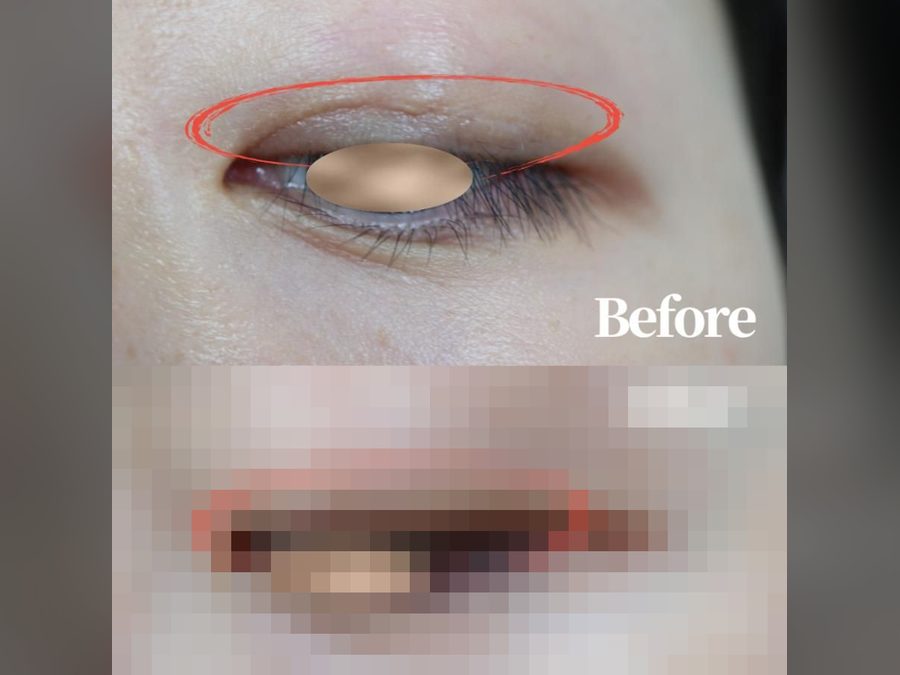
Thick, bumpy eyelid crease after double eyelid surgery: is it scar tissue, and can laser fix it without revision? (with a real case)
A thick, wavy or hard double eyelid crease months after surgery is often scar tissue. How to tell it from swelling or design issues, and how laser treatment works without revision surgery, with a real case.
Dr. Kang's columnBefore-and-after photos are unretouched photos of real patients. Results and how long they last vary by person. Like any medical procedure, treatment can have side effects such as pain, bleeding, bruising, swelling, infection, perforation, pigmentation or scarring. Please consult the doctor before treatment.