- If months after double eyelid surgery (blepharoplasty) the crease still looks puffy and thick ("sausage eyelids"), or looks wavy, bumpy and feels hard, the cause is often scar tissue that formed along the incision line.
- At Dr. Sun Clinic in Seoul, eyelid scar tissue is not cut out; it is treated with a laser-based combination, usually without anaesthesia, in 5–15 minutes. Many patients are satisfied after 3–4 sessions spaced 4–6 weeks apart.
- Recovery: about a week of stinging and swelling, 2–3 weeks of redness, and the crease often looks visibly thinner and softer from around week 3.
- Structural problems—such as a crease designed at the wrong height or eyes that don't close fully—need a revision consultation or an eye doctor first.
※ Results and side effects vary between individuals; an in-person examination is needed to confirm your condition.
“Doctor, it has been eight months since my double eyelid surgery and the crease is still thick and bumpy. Is revision surgery my only option?”
Hello, I'm Dr. Kang Jeong Joong, medical director of Dr. Sun Clinic in Seoul.
Many people waited after double eyelid surgery, trusting that "it will look natural once the swelling goes down," only to find that half a year later the crease still looks puffy, or the incision line looks wavy and bumpy when they close their eyes. Some can feel a hard band along the crease.
In this article I explain why eyelid scar tissue forms, how to tell it from swelling or a crease-design problem, how it is treated with laser without revision surgery, what recovery looks like, and a real treated case.
Videos from Dr. Sun Clinic
Why does scar tissue form after double eyelid surgery?
Eyelid skin is among the thinnest skin on the body. Whether the crease is made by incision or by sutures, a wound heals along that line; if too much collagen is produced, firm scar tissue remains under the crease.
Scar tissue can make the crease look thicker and puffier than it really is—sometimes like a sausage—make the incision line look wavy and bumpy when the eyes are closed, and make the area feel hard. Repeated revisions damage the tissue again and again, so scar tissue becomes more likely.
Because it sits right under very thin skin, even a small amount of scar tissue is easy to see, which is why it bothers patients so much.
How do I tell scar tissue from swelling or a crease-design problem?
For the first 1–3 months, swelling makes the crease look thick. Swelling is soft, worse in the morning, better in the afternoon and improves over time. Scar tissue still feels like a firm band along the crease after several months, and the thickness and bumpiness barely change.
If the crease was designed too high or too low, if the two sides sit at different heights, or if the eyes don't close properly, the problem may be structure and design rather than scar tissue. Scar treatment alone won't fix those.
In practice, scar tissue is often mixed with other causes. Photos with eyes open, eyes closed and from the side, plus the date and number of surgeries, show how much of the problem is scar tissue.
Can eyelid scar tissue be treated without revision surgery?
When scar tissue is the main cause, improvement without another operation is possible in many cases. Dr. Sun Clinic does not cut or shave scar tissue and does not inject drugs. A laser-based treatment, combined with radiofrequency and micro-needles where needed, changes the scar tissue so the body's healing process rebuilds it closer to your original skin.
Eyelid scar tissue is usually treated without anaesthesia. It is generally not very painful, and anaesthetic fluid in the thin eyelid would hide the scar tissue so it could no longer be seen or felt, making precise treatment harder.
Scar tissue after epicanthoplasty (inner-corner surgery) is treated on the same principle. The photo below shows an epicanthoplasty scar about two months after one session.
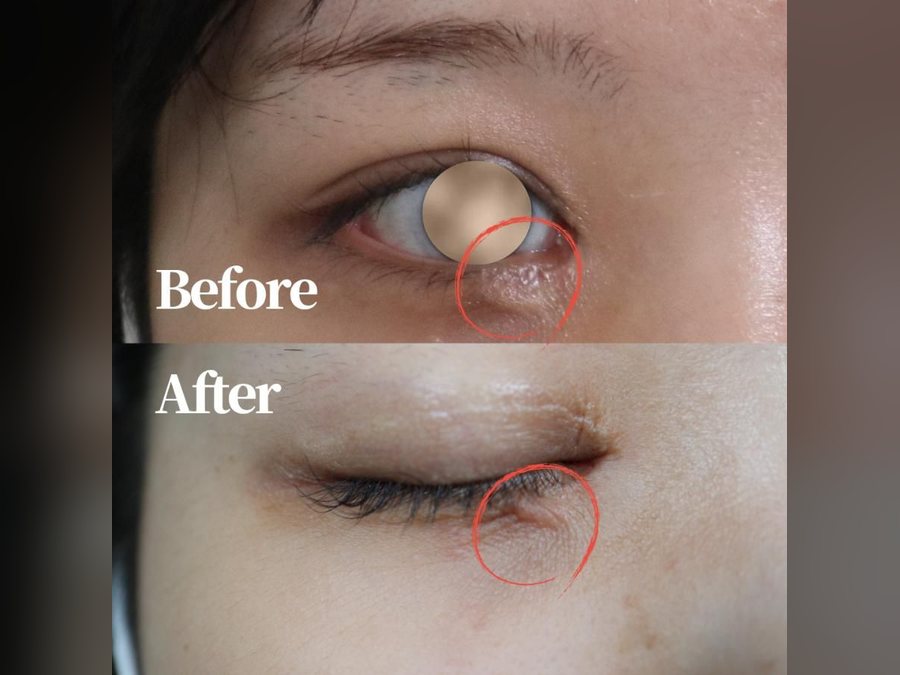
Before-and-after photos are unretouched photos of real patients. Results and how long they last vary by person. Like any medical procedure, treatment can have side effects such as pain, bleeding, bruising, swelling, infection, perforation, pigmentation or scarring. Please consult the doctor before treatment.
Unretouched photos of real patients, shown with consent. Eyes are masked. Results vary.
What do treatment and recovery look like? Week 1, week 3 and number of sessions
Most sessions take 5–15 minutes. For about a week afterwards the eyelids may sting and be swollen; apply the eye ointment twice a day for 7 days and avoid eye make-up and chemical products during that time.
Redness may last 2–3 weeks, and from around week 3 the crease often looks visibly thinner and softer. Sessions are usually 4–6 weeks apart, and many patients with eyelid scar tissue are satisfied after 3–4 sessions.
For a wavy crease around the eyes, downtime (stinging, dryness, itching) can last 1–2 weeks, but it often becomes much smoother after 2–3 sessions. Showers and daily life are fine; avoid saunas and baths.
When should I see a surgeon or eye doctor first?
If your eyes don't close fully and the cornea dries out, if the eyelid droops enough to block your vision, or if the crease height or position itself is wrong, a revision consultation or an eye doctor comes before scar treatment. Sudden redness, heat or pus means contacting your surgeon right away.
Even if you are planning revision surgery, reducing scar tissue first can help assess the tissue accurately. If you are unsure of the order, send photos first.
This case at a glance
Wavy crease after double eyelid surgery: one laser session
A patient who came in with a wavy incision line after double eyelid surgery.
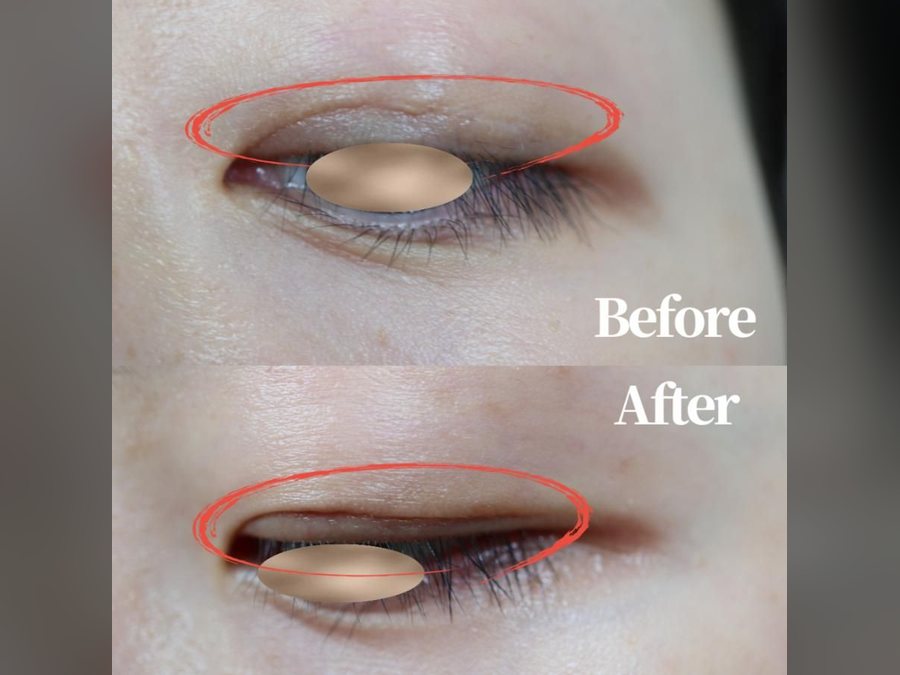
- Before treatment (2026.05.06)
A wavy texture visible along the incision line
- 1 laser session
Eyelid scar tissue laser
- About 4 weeks later (2026.06.02)
Progress after one session
The change shown is after a single session; the number of sessions needed depends on the thickness and condition of the scar tissue.
Before-and-after photos are unretouched photos of real patients. Results and how long they last vary by person. Like any medical procedure, treatment can have side effects such as pain, bleeding, bruising, swelling, infection, perforation, pigmentation or scarring. Please consult the doctor before treatment.
Unretouched photos of real patients, shown with consent. Eyes are masked. Results vary.
How Dr. Sun Clinic treats it
The medical director personally handles consultation, treatment and follow-up. Eyelid skin thickness varies from the inner to the outer crease, so intensity is adjusted for each part, and the combination is changed in real time as the tissue responds.
After each session, progress is checked with photos and the next session is planned again. International patients can get an estimated number of sessions and a schedule through a photo consultation.
3 key points
- A crease that is still thick, wavy or hard months after surgery is likely scar tissue.
- Eyelid scar tissue is usually treated without anaesthesia in 5–15 minutes; many patients are satisfied after 3–4 sessions 4–6 weeks apart.
- Structural problems such as crease design or incomplete eye closure need a revision consultation or eye doctor first.
Questions patients ask
Is laser for eyelid scar tissue painful?
It is usually mild enough to be done without anaesthesia. How it feels varies from person to person, and most sessions take 5–15 minutes.
How long is the downtime after eyelid scar laser?
About a week of stinging and swelling, and redness for 2–3 weeks. Avoid eye make-up during that time.
How many sessions does eyelid scar tissue need?
Sessions are usually 4–6 weeks apart, and many patients are satisfied after 3–4. It depends on the thickness and condition of the scar tissue.
Can laser help sausage eyelids?
If the crease looks thick because of scar tissue, laser can help reduce the thickness. If the crease was simply designed too high, a revision consultation may be needed.
If you are dealing with this
When a double eyelid crease looks wrong, revision surgery is often the first thought. But if the cause is scar tissue, there may be a way to improve it without cutting again—and repeated revisions can add more scar tissue, so finding the cause comes first.
Send photos with your eyes open, closed and from the side, along with the date of your surgery, and I will tell you personally whether scar tissue is involved and how to approach it. Photo consultations are available in 15 languages wherever you live.
This has been Dr. Kang Jeong Joong of Dr. Sun Clinic. Thank you for reading.
Send us photos and Dr. Kang will review them and reply personally.
Evidence and references
- Seago M, et al. Laser Treatment of Traumatic Scars and Contractures: 2020 International Consensus Recommendations. Lasers Surg Med. 2020;52(2):96-116.International expert consensus on laser treatment of traumatic and surgical scars and contractures (2020). Individual results vary.
- Anderson RR, et al. Laser treatment of traumatic scars with an emphasis on ablative fractional laser resurfacing: consensus report. JAMA Dermatol. 2014;150(2):187-193.Consensus report on traumatic scar treatment centred on ablative fractional lasers (2014).
Related articles
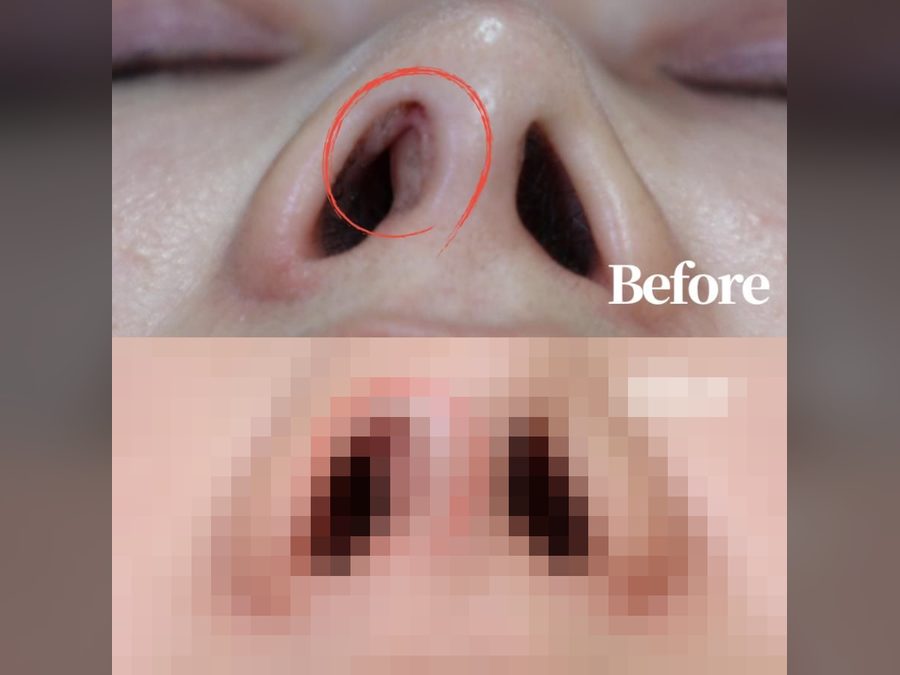
Hard scar tissue inside the nose after rhinoplasty: can laser reduce it without revision surgery? (with a real case)
Hard scar tissue inside the nostril after rhinoplasty can often be softened with combined laser and RF instead of revision surgery. Causes, treatment, recovery and a real case, explained by Dr. Kang Jeong Joong.
Dr. Sun Clinic column
Why does my face feel lumpy and stiff after facial contouring? Scar tissue, adhesion and treatment without revision surgery
Lumps, tightness or stiff expressions months after facial contouring are often scar tissue and adhesion. How to tell them from swelling or nerve problems, and how laser treatment works without revision surgery.
Dr. Kang's columnBefore-and-after photos are unretouched photos of real patients. Results and how long they last vary by person. Like any medical procedure, treatment can have side effects such as pain, bleeding, bruising, swelling, infection, perforation, pigmentation or scarring. Please consult the doctor before treatment.